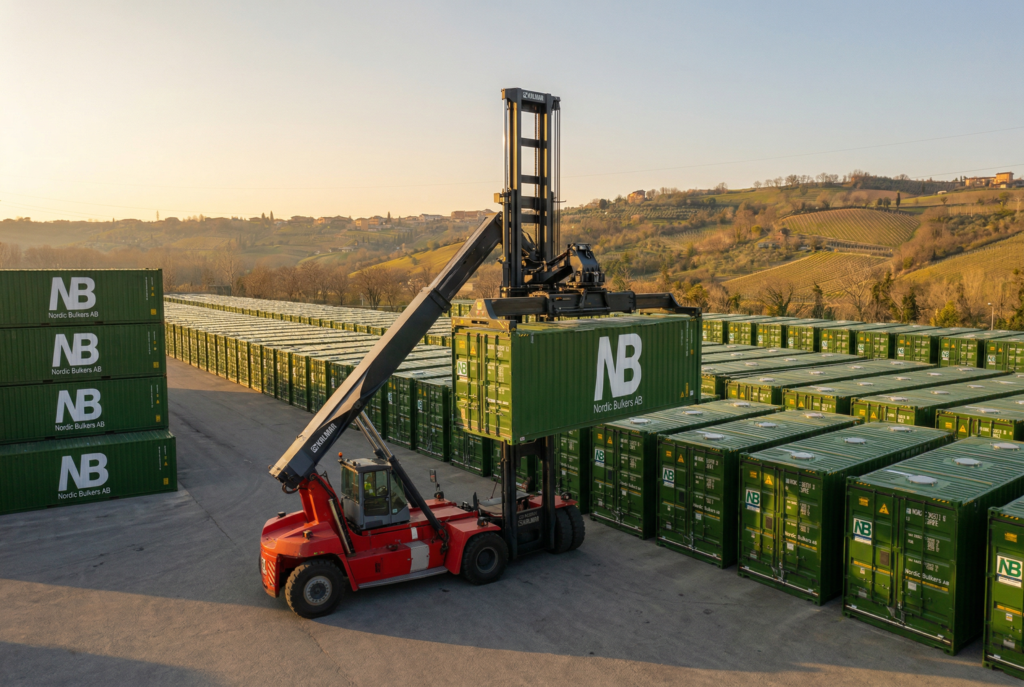
Bulk containers are specialized units designed to transport unpackaged materials—such as polymers, powders, minerals, grains, and food ingredients—safely and efficiently across intermodal supply chains.
Understanding Types of Bulk Containers
Bulk containers are engineered transport units used to move flowable solid materials in unpackaged form, offering sealed, efficient, and contamination-free handling across road, rail, and sea.
Definition and Purpose
Unlike standard shipping containers, bulk containers are specifically designed to carry dry materials that flow—such as pellets, granulates, powders, and small particulate solids. These containers support intermodal logistics and are integral to industries that rely on high-volume raw material flows.
Bulk containers eliminate the need for bagging, reduce handling labor, and protect sensitive materials from dust, moisture, and contamination, making them essential for plastics, chemicals, food ingredients, minerals, agriculture, and recycling.
Common Types of Bulk Containers
Bulk containers come in several forms, each tailored to specific material types and flow characteristics.
Common Systems
1. Standard Dry Bulk Containers
Used for most polymer granulates, minerals, and industrial solids.
Features:
20ft or 30ft formats
Gravity or pneumatic loading
Lined with food-grade or industrial liners
Suitable for intermodal rail–road–sea transport
2. 30ft High-Volume Bulk Containers
Favored by Nordic Bulkers for polymers, powders, and food-grade materials.
Benefits:
High payload efficiency
Exceptional stability
Designed for pneumatic unloading
Optimized for European intermodal logistics
3. Bag-in-Box / Lined Containers
Designed for materials that require extra contamination prevention.
Applications:
Food-grade powders
Hygroscopic materials
Sensitive polymer grades
4. Pressurized Bulk Containers
Used for fine powders requiring controlled discharge.
Characteristics:
Steel build
Pressurized unloading
Ideal for cement, lime, or pressure-sensitive powders
5. ISO Tank Containers (Liquid Bulk)
(Not part of Nordic Bulkers’ core services, but relevant for comparison)
Used for:
Edible oils
Chemicals
Liquid food products
They transport liquids rather than dry bulk materials.
Types of Bulk Containers Used by Nordic Bulkers
Nordic Bulkers specializes in engineered 30ft dry bulk containers with sealed liners and high-performance unloading systems.
Container Design Features
Nordic Bulkers’ fleet includes:
30ft dry bulk containers designed for payload stability
Food-grade liners for sugar, starch, flour, cocoa, and food powders
Industrial-grade liners for polymers, minerals, and chemical powders
Antistatic options for specific polymer grades
Pneumatic and gravity discharge systems
Rail-road-sea compatibility for full intermodal flexibility
These containers offer exceptional cleanliness, safety, and versatility.
How Bulk Containers Are Used in Logistics
Bulk containers support seamless intermodal transport by keeping materials sealed from loading to unloading.
End-to-End Workflow
Material loading using gravity or pneumatic systems
Container sealing with tamper-proof closures
Road transport to terminal or port
Rail transport for long-distance, low-emission movement
Short-sea shipping connecting European regions
Terminal handling, optional storage or repacking
Pneumatic or gravity unloading into silos or production lines
This sealed supply chain reduces contamination, product loss, and environmental impact.
Safety, Quality, and Environmental Compliance
Bulk containers must meet strict standards for contamination control, moisture protection, and environmental responsibility.
Nordic Bulkers’ Standards
Nordic Bulkers maintains:
ISO 9001 – Quality Management
ISO 14001 – Environmental Management
ISO 22000 – Food Safety (for food-grade cargo)
Operation Clean Sweep for preventing pellet leakage
Moisture-proof liners
Dust-free unloading technologies
Rail-first strategies minimizing CO₂ emissions
This ensures secure, sustainable bulk container operations across Europe.
Why Bulk Containers Matter
Bulk containers reduce costs, support sustainability, enhance product quality, and streamline supply chain flows for high-volume industries.
Key Advantages
Zero packaging waste
Higher payload efficiency
Cleaner and safer handling
Less labor-intensive logistics
Lower CO₂ emissions
Better material integrity
Seamless intermodal transport
With Nordic Bulkers’ engineered container systems, companies gain a reliable, scalable, and sustainable solution for transporting dry bulk materials across Sweden and Europe.
We use cookies to enhance your experience on our website. These include cookies necessary for the website's functionality and optional cookies for analytics purposes.